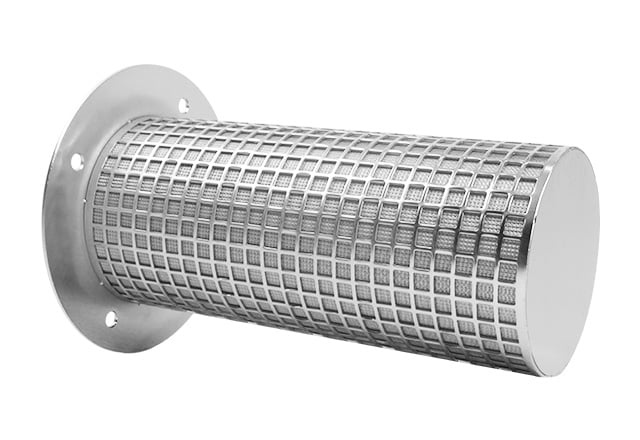
An industrial tank filter basket is specified around the tank opening, insertion depth, flow path and removal method. The basket can use perforated metal, woven mesh or a supported combination to collect debris, protect an outlet or screen recirculating process liquid.
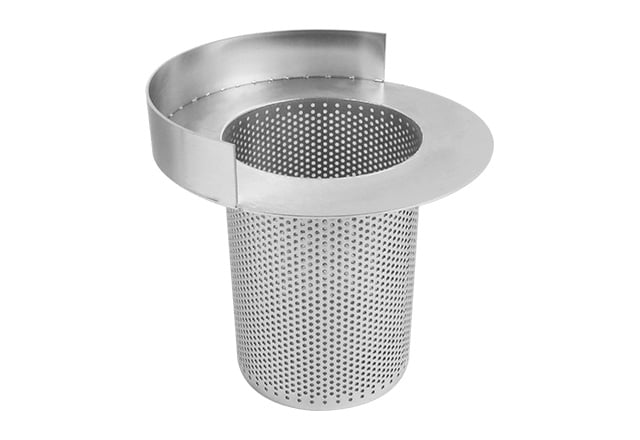
Drop-in perforated basket with a tank-mounted flange and equipment-specific locating feature.
Where a Tank Filter Basket Fits
Tank return point
Captures particles before recirculating liquid re-enters the tank.
Outlet protection
Screens debris before liquid reaches a pump, valve or downstream component.
Open-tank collection
Provides a removable basket for solids entering through a defined opening.
Process cleaning tank
Separates released debris from circulating cleaning liquid; not a parts-holding basket.
Industrial Tank Filter Basket Specification Table
Start with the tank drawing and flow path. Basket diameter alone does not define the mounting interface, depth, removal clearance or filtration behavior.
RFQ field
What to provide
Tank-specific reason
Installation point
Return, outlet, suction, overflow or drop-in opening
Defines flow direction and access
Tank interface
Opening, seating face, flange OD, bolt pattern or locating feature
Controls fit, support and possible bypass
Basket envelope
OD/profile, insertion depth, active length and bottom clearance
Prevents interference inside the tank
Filtration media
Perforation or mesh construction, opening/rating and support
Defines retained solids and flow area
Removal details
Handle, lifting direction, clearance and loaded-basket condition
Supports practical cleaning and maintenance
Process duty
Medium, temperature, solids, flow, cleaning and quantity
Provides context for material and construction review
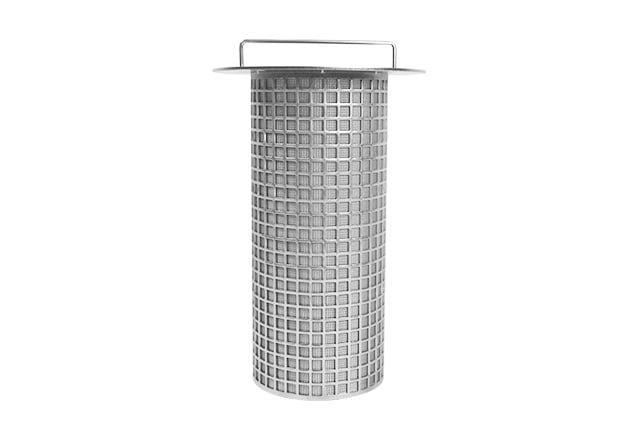
Handle-equipped basket designed for vertical removal from a tank opening.
Mounting, Insertion Depth and Removal Access
A drop-in basket may rest on a flange, locate in a collar or bolt to a tank plate. State the seating face, opening size, bolt pattern where used, insertion depth and minimum bottom clearance.
The handle must fit through the access opening and remain reachable. Consider the basket weight after solids are collected, but do not assume a safe lifting load without the required service data.
Rigid punched sheet for coarse debris collection or as a support shell.
Woven mesh basket
Finer square openings where mesh count, wire diameter and aperture are defined.
Composite basket
Fine woven media supported by perforated metal or a heavier wire structure.
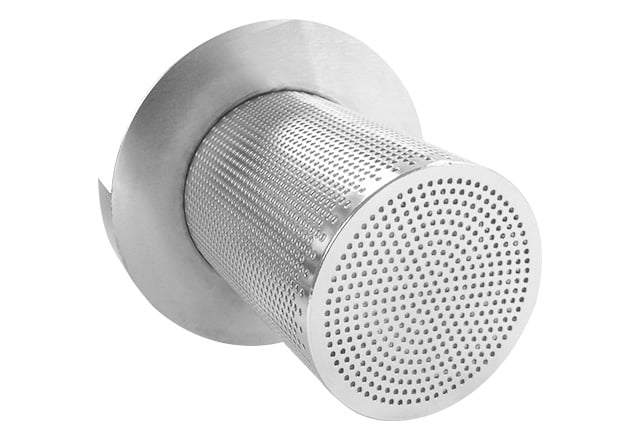
Closed perforated bottom and wide seating flange shown from the tank side.
Opening and active area
For perforated construction, specify hole size, pitch, pattern and unperforated margins. See the custom perforated filter basket page for sheet-based construction.
For woven media, specify mesh count with wire diameter or clear aperture. Review stainless steel mesh for filtration when the retention layer is finer than the support body.
These real product examples show different tank interfaces, bottoms, handles and filtration-layer structures. Final geometry is controlled by the customer drawing.
Drop-in perforated basket with a tank-mounted flange and equipment-specific locating feature.
Drop-in perforated basket
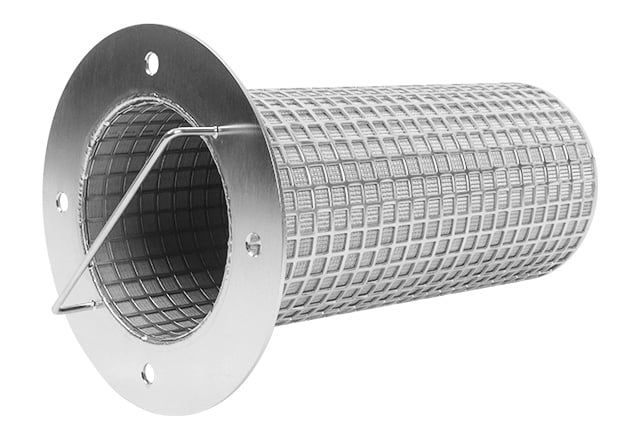
Flanged mesh element with mounting holes and a removal bar for equipment access.
Bolted mesh basket element
Closed-end mesh cylinder with a bolt-hole flange for a drawing-specific tank interface.
Closed-end flanged mesh element
Handle-equipped basket designed for vertical removal from a tank opening.
Handle-equipped removable basket
Flow Direction, Debris Loading and Cleaning
Flow path
Mark whether liquid enters through the top, side or outside surface and where it exits.
Collected solids
Describe particle type, approximate size and expected loading rather than only giving a micron number.
Cleaning method
State manual rinse, spray, ultrasonic or another approved process if it affects material or construction.
Removal cycle
Confirm access and maintenance expectations without assuming an unsupported service interval.
Five-Step Tank Filter Basket RFQ Workflow
1. Map the tank
Identify opening, liquid level, flow path and surrounding clearances.
2. Define retention
State particle target and perforation or mesh construction.
3. Size the basket
Add flange, OD/profile, depth, bottom clearance and active area.
4. Add handling details
Define handle, removal direction, support, seams and bottom.
5. Complete the RFQ
Attach drawing, process duty, quantity and acceptance requirements.
It is a removable or fixed basket installed at a tank opening, return point, outlet or suction area to collect debris or protect downstream equipment. Its mounting flange, depth, opening, handle, bottom and filtration media are matched to the tank and process.
A tank filter basket controls fluid flow and contaminant capture at a defined tank interface. A parts washing basket primarily holds components during cleaning. The mounting, filtration opening, flow direction and sealing requirements are therefore different.
Perforated metal provides a rigid coarse screen or support. Woven mesh can provide finer openings. A composite basket can combine both when fine retention and structural support are needed.
Provide the tank opening, seating or bolt pattern, basket OD or profile, insertion depth, active length, bottom clearance, handle envelope, material, perforation or mesh, tolerances and removal direction.
For perforated metal, state hole shape, size, pitch and pattern. For square woven mesh, state mesh count with wire diameter or aperture. For dense or multilayer media, state the construction and rating basis.
State the liquid or process medium, temperature, expected solids, flow direction, flow rate if known, differential head or pressure where relevant, cleaning method, removal frequency, quantity and acceptance requirements.
Request a Tank Filter Basket Drawing Review
Send the tank opening, mounting interface, basket depth, filtration media, flow direction, handle, bottom, process conditions and quantity.