Custom stainless steel wire mesh baskets hold and protect components during washing, rinsing, draining, transfer, storage or other industrial processes. Specify the contained parts, basket envelope, opening, frame, load, lifting method, lid or dividers and process conditions together.
A basket cannot be responsibly quoted from outside dimensions alone. The part geometry, load distribution and handling method are essential design inputs.
RFQ field
What to provide
Why it matters
Contained parts
Smallest dimensions, shape, weight, quantity and orientation risk
Determines the required opening and containment
Basket envelope
Length, width, depth, corner radius and equipment clearances
Controls fit inside racks, tanks or machines
Opening structure
Woven mesh, welded grid or perforated sheet; opening and wire/sheet data
Balances retention, drainage and process access
Frame and reinforcement
Top frame, ribs, bottom support, feet and weld locations
Connects geometry to the stated handling load
Handling features
Handles, hooks, lifting points, lid, latch, dividers and stacking features
Defines operation and movement
Process conditions
Medium, temperature, cycle, cleaning and contact requirements
Supports material and construction review
Acceptance
Drawing revision, tolerances, quantity and required inspection
Creates a verifiable purchase specification
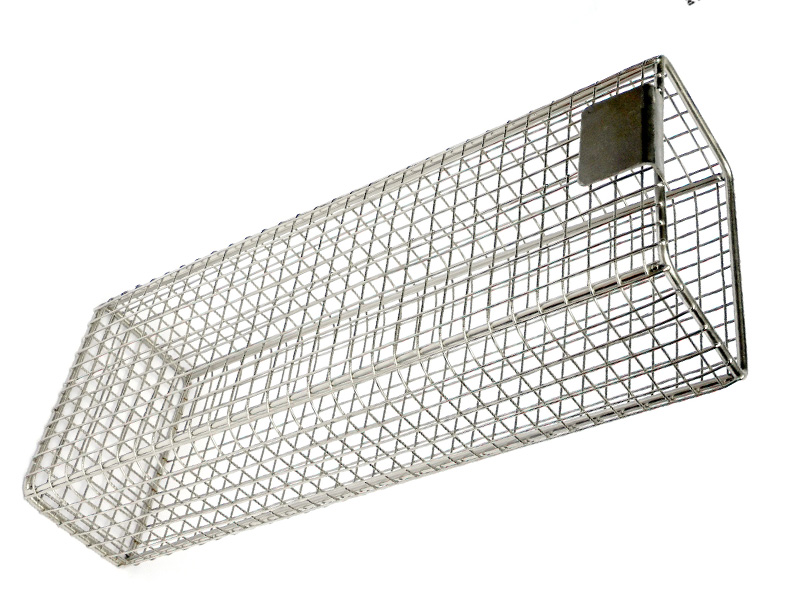
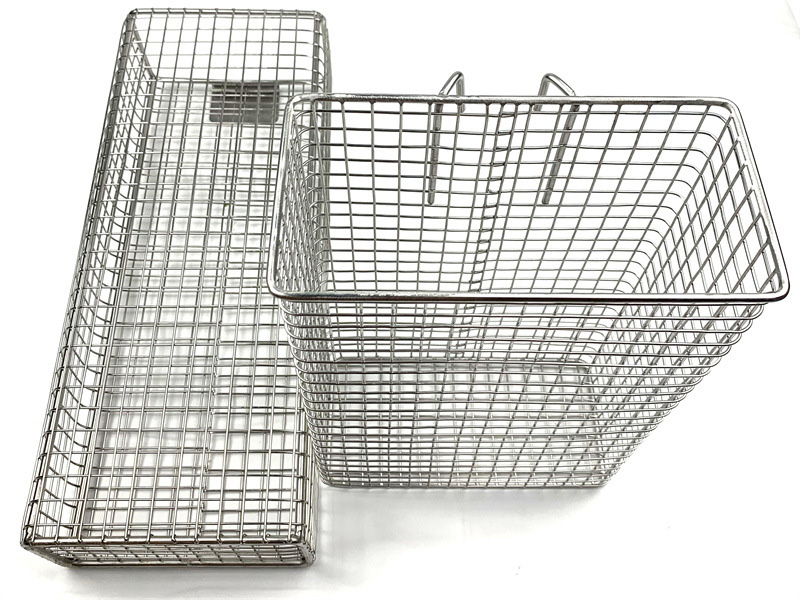
Long rectangular basket with grid walls and reinforced frame.
Choose the Opening Around the Smallest Part
The opening must prevent parts from escaping in any expected orientation while allowing liquid, air or process access. Woven mesh suits finer containment, while welded grid provides a more open rigid structure. Perforated sheet can provide controlled holes and a continuous formed wall.
When a woven opening is specified, the mesh-to-micron calculator can help check square aperture geometry, but part retention still depends on actual dimensions and orientation.
Available Basket Configurations
Open basket
Uncovered format for direct loading, washing, draining and removal.
Lidded basket
Fixed, hinged or removable cover where parts must remain contained.
Divided basket
Internal compartments separate parts or limit contact during processing.
Stackable basket
Feet, frames or locating features coordinate stacking and load transfer.
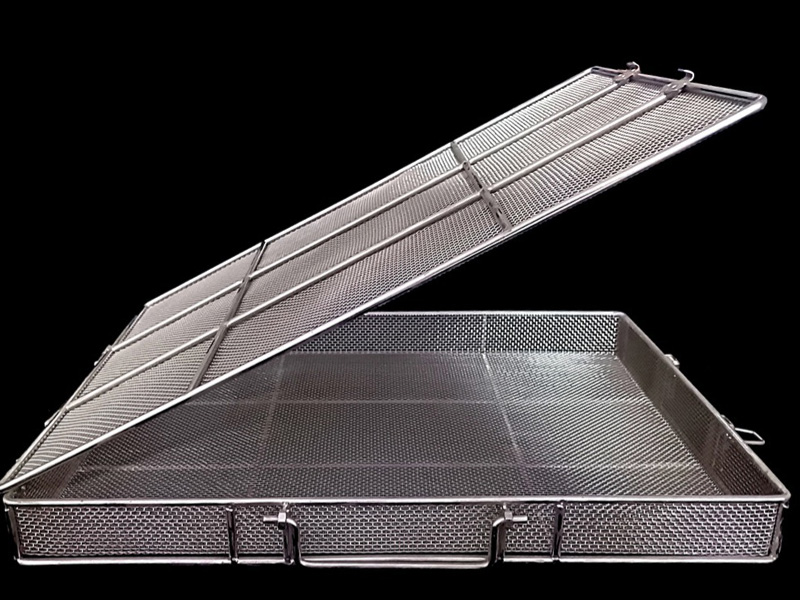
Fine-mesh processing basket with a fitted lid and reinforced frame.
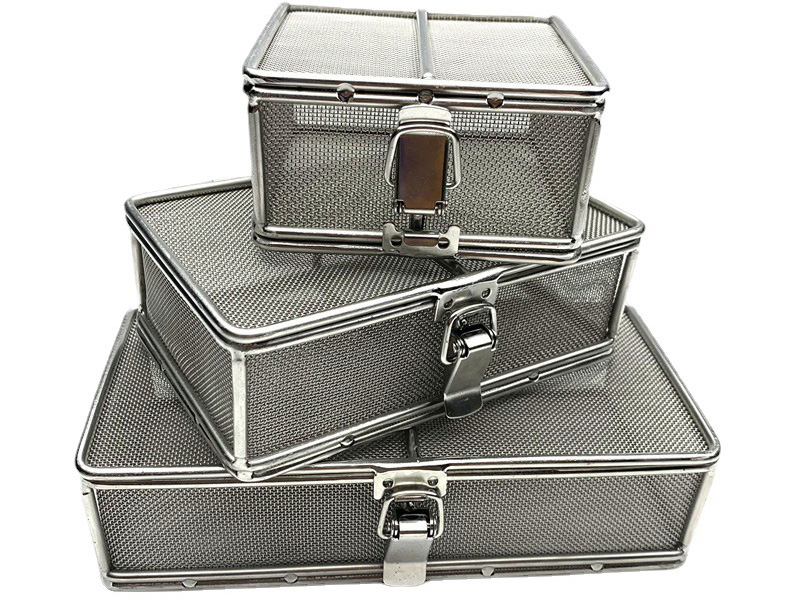
Lidded mesh baskets in multiple sizes with framed edges and latches.
Handles, Hooks and Lifting Details
Handling features must be treated as functional load interfaces. State whether the basket is lifted manually, by hooks, by a hoist or as part of an automated rack. Show lifting direction, loaded weight, handle movement and the available clearance.
Fixed or folding handles
Wire hooks and hanging points
Latches and lid retention
Feet, runners and stacking stops
Equipment-specific mounting tabs
Open grid baskets showing different proportions and hook details.
Material and Construction Selection
Stainless steel wire
Used for frames, welded grids, handles and reinforcement where compatible with the process.
Woven stainless mesh
Provides fine containment and free process access; specify mesh and wire diameter together.
Welded wire grid
Provides a defined open grid with joints and frame integration controlled by the drawing.
Perforated sheet
Uses hole size, pitch, sheet thickness and formed geometry to define the wall.
Material must be selected from the actual chemistry, temperature, cleaning and fabrication requirements. Use the 304 vs 316 stainless steel selection guide as a starting comparison, not as a substitute for process compatibility review.
Real Maidong Basket Examples
Real wire and mesh basket configurations for drawing-based fabrication.
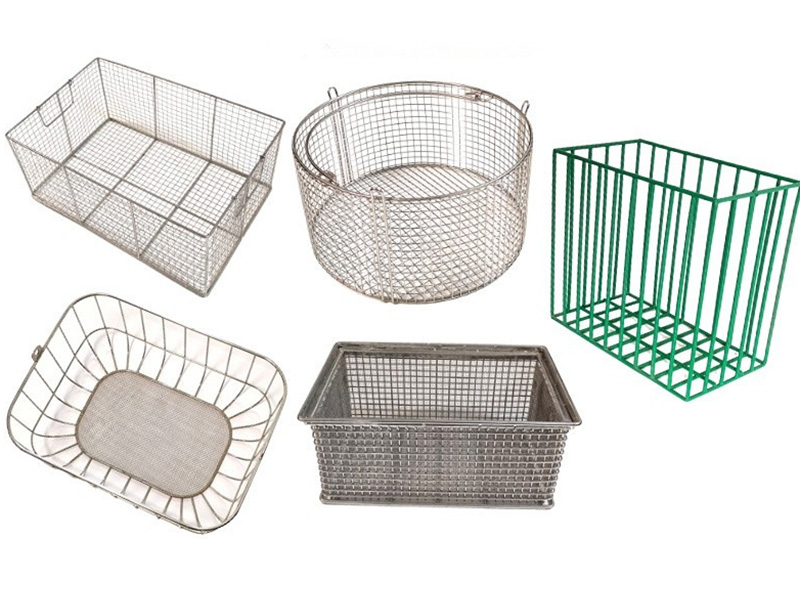
Multiple basket geometries
Fine-mesh processing basket with a fitted lid and reinforced frame.
Fine-mesh lidded basket
Open grid baskets showing different proportions and hook details.
Open grid parts baskets
These photographs show real basket configurations from the Maidong material library. They are examples of construction and geometry—not standard sizes, stock claims or load-capacity claims.
Typical Industrial Uses
Parts washing
Contains components through compatible washing, rinsing and draining steps.
Process transfer
Moves parts between approved operations while keeping the batch together.
Storage and organization
Separates, protects or identifies parts in racks, cabinets or work cells.
Surface-treatment handling
Carries compatible parts through a buyer-defined treatment process and handling system.
How to Prepare a Custom Basket RFQ
1. Describe the parts
Give smallest dimensions, weights, quantity and orientation risk.
2. Define equipment fit
Provide basket envelope and machine, tank or rack clearances.
3. Choose containment
Specify opening, wire or sheet construction and drainage need.
4. Define handling
Show load, lifting points, handles, lid, dividers and stacking.
5. Add process data
State medium, temperature, cycle, material, quantity and inspection.
It is a fabricated basket used to contain, carry, wash, drain, store or protect components during an industrial process. It is specified from the parts, load, handling method, process equipment and environment.
No. This page focuses on parts handling and process baskets. A filter basket is installed in a filtration housing and is specified from fluid flow, particle retention, differential pressure and sealing requirements.
The opening must retain the smallest part while allowing the required liquid, air or process access. State the smallest component dimension, orientation risk and required drainage rather than selecting mesh from a generic chart alone.
Provide total load, individual part weight, load distribution, lifting points, stacking condition and any impact or handling duty. Maidong does not infer safe load capacity from outside dimensions alone.
Drawing-based fixed or removable lids, latches, handles, hooks, dividers, feet and stacking features can be reviewed. Show their positions, movement, clearances and intended functions.