A custom conical wire mesh filter is defined by its cone geometry and filtration medium together. Specify the large and small diameters, axial length or controlled angle, mesh construction, support, seam, rim or flange, flow direction and service conditions.
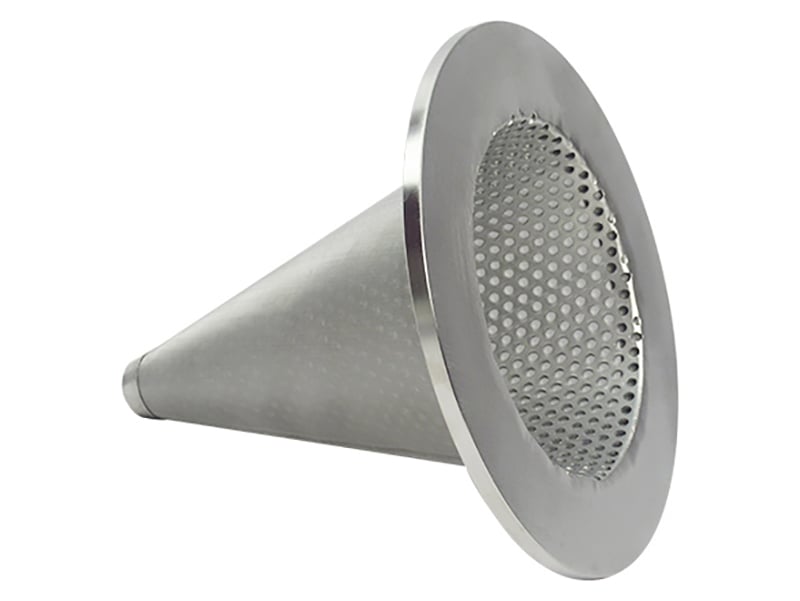
Real Maidong conical filter with a drawing-defined mesh body and flange.
Conical Filter Geometry Must Match the Installation
The cone shape can provide a compact screen area and a defined debris-collection direction, but it is not a universal substitute for a cylinder or basket. This page focuses on custom wire-mesh cone components made to drawing. For the general navigation product family, see conical filters.
Full cone
Tapers toward a closed or formed tip and requires a defined seam and end detail.
Truncated cone
Uses controlled large and small openings with drawing-defined edge treatment.
Flanged cone
Includes a mounting or sealing flange whose dimensions must match the mating part.
Supported cone
Combines fine woven mesh with perforated metal or another approved support.
Conical Wire Mesh Filter Specification Table
A request for only “a cone filter in 316 mesh” is not quotation-ready. Add the finished geometry, interface and operating duty.
RFQ field
What to provide
Why it matters
Cone geometry
Large-end OD/ID, small-end OD/ID, axial length and controlled angle
Defines fit, area and forming geometry
Filter medium
Weave, mesh count + wire diameter or aperture; rating basis
Defines the retention layer
Material
Required alloy and applicable material specification
Connects the part to process compatibility
Support and layers
Perforation, thickness, layer order and high-pressure side
Controls deformation and flow path
Seam and tip
Longitudinal joint, overlap, weld and closed-end detail
Limits bypass and defines strength
Rim / flange
OD, ID, thickness, hole pattern, sealing face and tolerances
Defines mounting and sealing
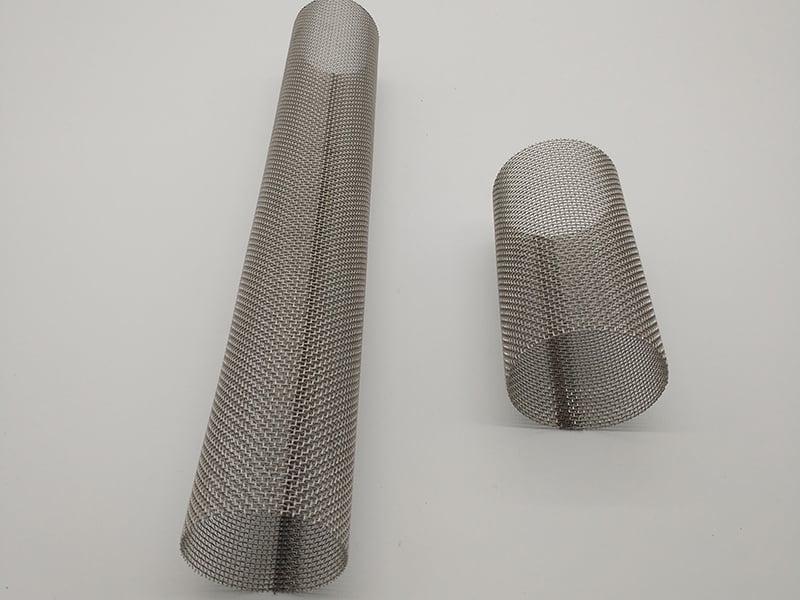
Woven wire mesh cone screens in different proportions.
Woven Mesh and Aperture Selection
Square woven mesh should be ordered by mesh count plus wire diameter, or by a required clear aperture. For terminology and preliminary calculations, use the mesh-to-micron calculator. It does not replace a validated filtration rating.
Dutch weave and multilayer media require construction-specific data. Review stainless steel mesh for filtration when selecting the underlying media.
Rim, Flange, Seam and Tip Options
Rolled or bound rim
Used where the edge needs reinforcement or a controlled handling surface.
Mounting flange
Define the mating face, outside and inside diameter, holes and sealing details.
Longitudinal seam
Show the seam orientation, overlap or butt arrangement and acceptable joining method.
Closed or open tip
Specify cap, formed closure, small outlet or truncated opening on the drawing.
Real Maidong conical filter with a drawing-defined mesh body and flange.
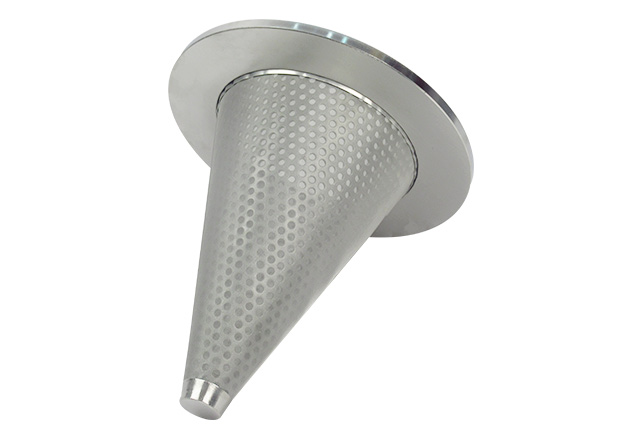
Conical filter example with perforated support and a wide mounting flange.
Product detail: the cone, wide-end rim and longitudinal seam shown from several angles. This 8-second silent clip is a visual reference; material, dimensions and filtration requirements are confirmed with the product specification.
Flow Direction and Structural Support
State whether flow travels from inside to outside or outside to inside, and identify the side exposed to higher pressure. Fine mesh may need perforated support where differential pressure, reverse flow, cleaning or handling could deform the cone.
Woven wire mesh cone screens in different proportions.
Woven mesh cones
Conical filter example with perforated support and a wide mounting flange.
Supported flanged cone
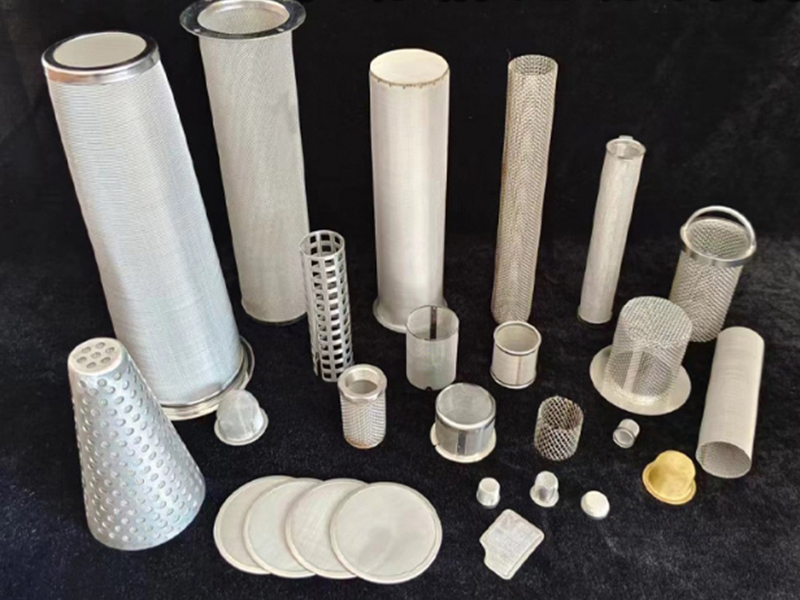
Maidong mesh and perforated filter component examples.
Custom filter component range
The images show real Maidong filter forms and construction options. They are examples only; the final cone must follow the approved drawing and agreed specification.
Typical B2B Procurement Uses
Temporary pipeline straining
For commissioning or temporary flange installation, review the dedicated temporary cone strainer screen page. Confirm flow direction, installation clearance and captured-debris allowance.
Equipment inlet protection
Drawing-based screen protecting a compatible nozzle, opening or downstream component.
Process screening
Cone-shaped separation component selected from particle, fluid and cleaning requirements.
OEM filter assembly
A formed mesh or supported cone incorporated into a customer-designed filtration system.
How to Prepare a Conical Filter RFQ
1. Send geometry
Provide a dimensioned drawing and mating interface. State whether a controlled cone angle is the included angle or the half-angle, identify the datum and distinguish axial length from slant length. Use the drawing and tolerance checklist to prepare the RFQ.
2. Define filtration
State mesh construction, aperture or rating basis.
3. Confirm support
Show layer order, perforation and flow direction.
4. Detail joining
Specify seam, tip, rim, flange and tolerances.
5. Add service data
Give medium, temperature, pressure, cleaning and quantity.
It is a cone-shaped or truncated-cone screen made from woven wire mesh, sometimes combined with perforated support and a rim or flange. The filter is manufactured to match a defined installation envelope and flow direction.
Provide the large-end and small-end diameters, axial length, cone angle when controlled, rim or flange dimensions, seam location, overall tolerances and the mating interface.
For square weave, state mesh count together with wire diameter or give a clear aperture. If a micron rating is used, state whether it is nominal or absolute and identify the test method.
Support should be reviewed when fine mesh may deform under differential pressure, cleaning or handling. State flow direction, the higher-pressure side and allowable perforation details.
A temporary cone strainer is one application of conical filtration geometry, usually installed between flanges for commissioning or debris capture. Not every custom conical mesh filter is a pipeline temporary strainer.
Send the drawing, mesh or aperture, alloy, cone dimensions, support, seam, rim or flange, flow direction, process medium, temperature, pressure differential, cleaning method and quantity.
Request a Custom Cone Filter Review
Send the drawing, mesh or aperture, alloy, support, seam, flange, flow direction, operating duty and quantity for review.