Plain Dutch weave combines relatively coarse warp wires with finer, closely packed weft wires in an over-one, under-one pattern. The dense construction creates an indirect filtration path for industrial liquid, gas and viscous-media filtration.
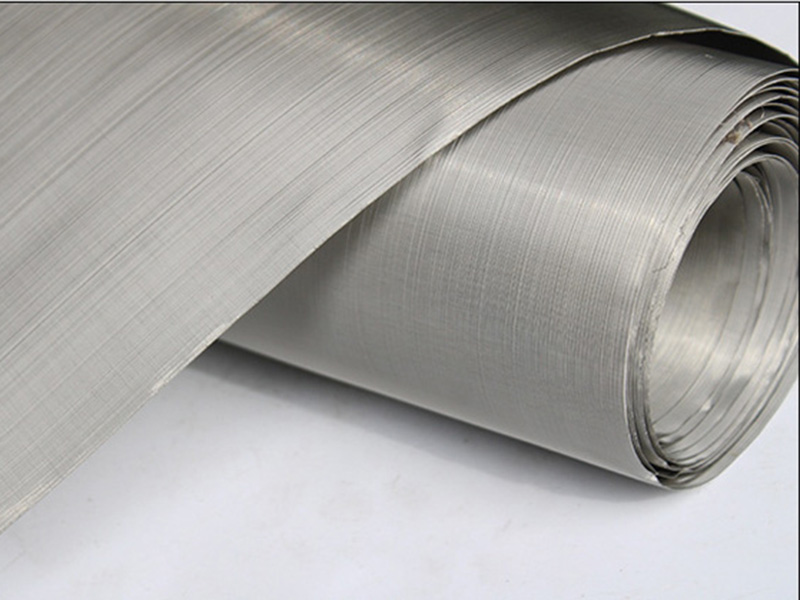
Dense Dutch weave filter cloth supplied in roll form.
Plain Dutch Weave at a Glance
Interlacing
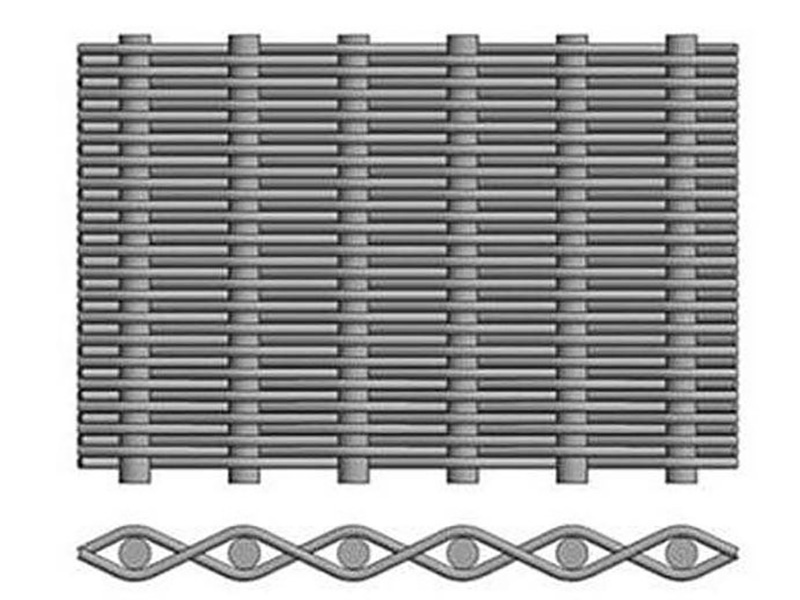
Each weft wire passes alternately over and under one warp wire.
Wire relationship
Coarser warp wires are combined with finer, more numerous weft wires.
Pore path
Closely packed wires form wedge-shaped and tortuous passages rather than square apertures.
Specification basis
State both mesh counts, both wire diameters, material and rating method.
Plain Dutch weave surface and cross-sectional interlacing diagram.
How Plain Dutch Weave Is Constructed
Plain Dutch weave follows the same one-over-one interlacing sequence as plain weave, but the warp and weft systems are deliberately different. The warp wires provide longitudinal support. Finer weft wires are placed close together across the width, leaving no simple straight-through square opening.
Particles are retained as the process medium follows narrow passages between adjacent wires. Because these passages are three-dimensional, filtration performance cannot be calculated from mesh count alone.
The examples below show how plain Dutch weave is commonly designated. They are not a Maidong stock list, guaranteed filtration ratings or confirmed production limits.
Warp × weft count
Example warp Ø
Example weft Ø
Specification note
12 × 64
0.58 mm
0.40 mm
Coarser plain Dutch reference construction
24 × 110
0.36 mm
0.25 mm
Common industry designation format
30 × 150
0.23 mm
0.18 mm
Finer reference arrangement
40 × 200
0.18 mm
0.14 mm
Dense plain Dutch reference arrangement
50 × 250
0.14 mm
0.11 mm
Fine reference arrangement
Purchasing rule: do not omit either wire diameter. Final availability, tolerances and filtration behavior must be confirmed against the agreed specification and test method.
Filtration Rating and Flow
Plain Dutch weave does not have a directly measurable square aperture. Suppliers may describe retention using geometric pore estimates, nominal ratings, absolute ratings or application-specific test results. These values are not automatically equivalent.
Confirm the rating definition and test method.
State the required flow and allowable pressure drop.
Include fluid viscosity, temperature and contamination load.
Clarify whether the mesh will be supported, layered or formed.
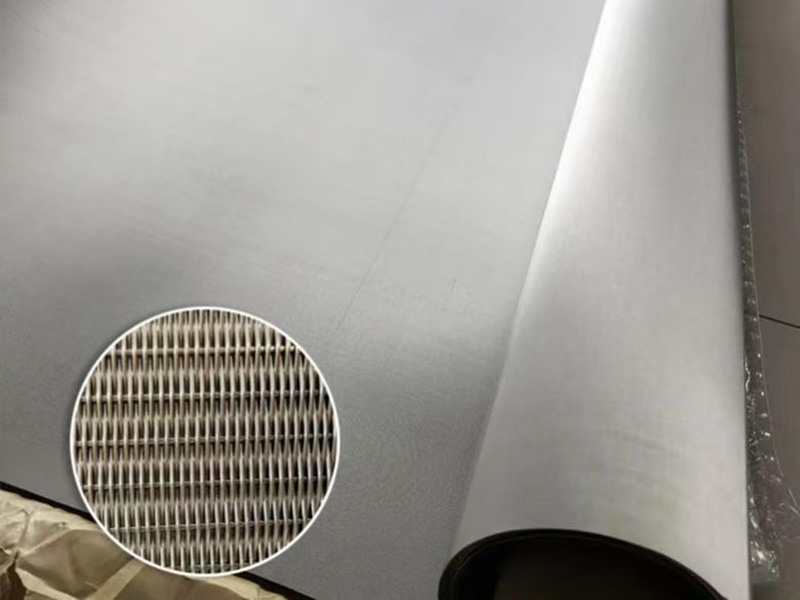
Dense Dutch weave surface with a magnified view of the wire structure.
Materials and Available Finished Forms
304 stainless steel
A general industrial option where its corrosion resistance is suitable for the process.
316 stainless steel
Often considered where chloride exposure or more aggressive process chemistry increases corrosion risk.
316L stainless steel
A lower-carbon 316 grade considered for specified welded or fabricated filter assemblies.
Plain Dutch weave may be supplied for evaluation as roll material, cut sheets, discs or fabricated cylindrical components, subject to the confirmed drawing and construction. See stainless steel wire mesh, filter discs and filter tubes for related forms.
How to Select Plain Dutch Weave
1. Define retention
State particle size and whether the target is nominal, absolute or based on a named method.
2. Define the process
Provide medium, viscosity, temperature, pressure differential and cleaning conditions.
3. Specify the weave
Give warp × weft counts, both wire diameters, material, width and tolerances.
4. Define the final form
State roll, sheet, disc or tube dimensions, support, seam, edge and quantity.
Common Industrial Applications
Plain Dutch weave is evaluated for industrial processes that need fine particle retention with a durable woven-metal medium. Final suitability depends on the complete system.
Hydraulic and lubricating oil
Fine contamination control where pressure drop and cleaning requirements are defined.
Process liquid filtration
Separation duties involving chemicals, water-based media or viscous process liquids.
Polymer and extrusion systems
Filter packs and fabricated elements where melt quality, flow and support must be balanced.
Plain Dutch Weave RFQ Checklist
Mesh specification
Warp × weft mesh count
Warp and weft wire diameters
Material grade and standard
Required rating and test basis
Width, length and tolerances
Operating and fabrication details
Process medium and viscosity
Temperature and pressure conditions
Flow and allowable pressure drop
Cleaning method
Finished form, drawing and quantity
The mesh-to-micron calculator is useful for square woven mesh only. Do not use its simple aperture formula as a Dutch-weave rating.
Plain Dutch weave is a dense woven filter cloth with different warp and weft wire diameters and counts. Each weft wire passes alternately over and under one warp wire. The closely packed weft wires create an indirect pore path rather than a visible square opening.
Plain square weave normally uses similar mesh counts and wire diameters in both directions and creates measurable square openings. Plain Dutch weave uses dissimilar warp and weft wires and forms wedge-shaped or tortuous filtration paths between packed wires.
Plain Dutch uses an over-one, under-one interlacing pattern. Twill Dutch uses a twill pattern that can accommodate denser wire packing and finer constructions. Selection should consider retention, flow, pressure, cleanability and mechanical requirements.
No. Warp and weft counts, both wire diameters, weave execution and the rating method must be considered. A square-weave mesh-to-micron formula does not provide a reliable Dutch-weave filtration rating.
304, 316 and 316L are commonly specified options, subject to the required construction and availability. Choose the grade from process chemistry, chloride exposure, temperature, cleaning method and fabrication requirements.
Send the warp-by-weft mesh count, both wire diameters, material, required rating and test basis, roll width and length or finished dimensions, tolerances, operating medium, temperature, pressure conditions and required quantity.
Request a Plain Dutch Weave Specification Review
Send the mesh designation, wire diameters, material, filtration target, operating conditions and required finished form. Maidong can review the information for a wire cloth or fabricated filter enquiry.